REsimpli Mastermind Recap – Why Your Offers Aren’t Getting Accepted (6th January, 2026)

Yesterday, we hosted our weekly REsimpli Mastermind session focused on a challenge nearly every investor faces at some point: why offers don’t get accepted. The conversation centered on negotiation fundamentals, seller psychology, follow-up, and how to present offers in a way that actually closes deals. Below is a recap of the key takeaways from the session.
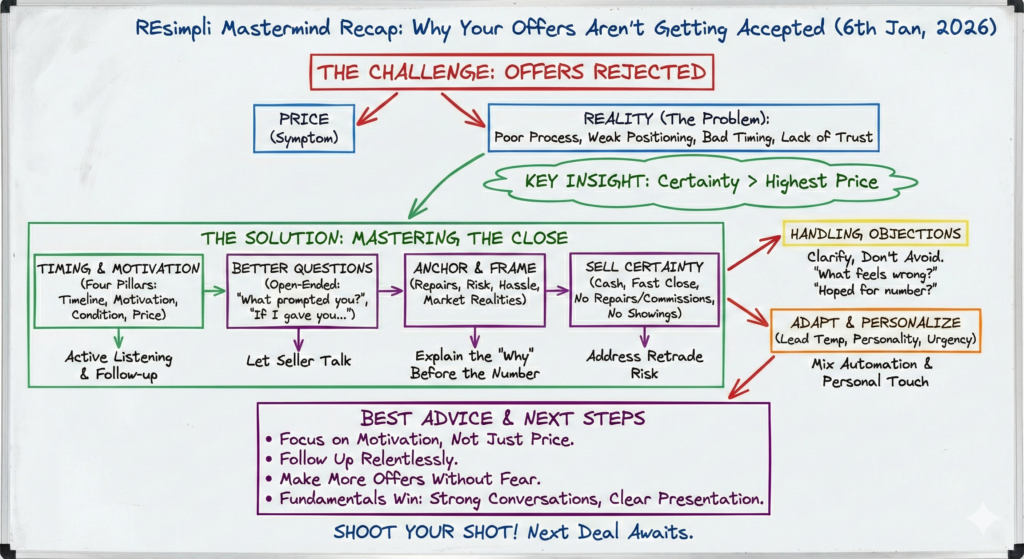
Topic: Why Price Isn’t the Real Reason Offers Fail
Challenge: Most investors assume their offer was rejected because the price was too low.
Reality: Price is usually the symptom, not the problem. Offers fail because of:
- Poor process
- Weak positioning
- Bad timing
- Lack of trust
Key Insight: If price were the only factor, sellers would always choose the highest offer. In reality, they choose the buyer who gives them the most certainty.
Topic: Making Offers Too Early or Too Late
Challenge: Investors often throw out numbers before fully understanding the deal or wait too long to make an offer.
Advice:
- Don’t offer before understanding motivation and condition
- Don’t delay offers assuming the seller will “still be there later”
- Time kills deals. Sellers are always talking to someone else
Best Practice: Use the four pillars of qualification:
- Timeline
- Motivation
- Condition
- Price
Key Insight: Off-market deals happen when timing and motivation intersect. Strong follow-up systems make sure you’re there when that moment hits.
Topic: Asking Better Questions to Uncover Motivation
Challenge: Many investors rely on yes/no questions or rush to price.
Advice:
- Ask open-ended questions that get sellers talking
- Let the seller do most of the talking
- Examples:
- “What prompted you to consider selling?”
- “If I gave you a $40,000 Home Depot gift card, what would you fix first?”
- “What would selling this property allow you to do?”
- “What prompted you to consider selling?”
Key Insight: Motivation often reveals itself over multiple conversations, not the first call. The best closers listen more than they talk.
Topic: Anchoring the Conversation Before the Offer
Challenge: Throwing out a number without setting context creates resistance.
Advice:
- Anchor the conversation around:
- Repairs
- Time
- Risk
- Hassle of listing on market
- Repairs
- Explain why selling off-market makes sense for their situation
- Discuss market realities, especially longer days on market and buyer hesitation
Key Insight: When sellers understand why the number is what it is, they’re far more likely to accept it.
Topic: Selling Certainty Instead of Price
Challenge: Investors compete on price instead of value.
Advice:
- Emphasize:
- Cash purchase
- Fast closing
- No repairs
- No commissions
- No showings
- Cash purchase
- Address higher competing offers by explaining retrade risk and uncertainty
Key Insight: Sellers choose certainty when time, stress, and simplicity matter more than squeezing out the last dollar.
Topic: Handling Objections Instead of Avoiding Them
Challenge: Many investors freeze or retreat when sellers push back.
Advice:
- Ask follow-up questions instead of backing off
- “What part doesn’t feel right?”
- “What number were you hoping to get?”
- Don’t fear uncomfortable conversations
Key Insight: Objections are not rejection. They’re invitations for clarification.
Topic: Treating Every Seller the Same
Challenge: Scripted conversations and identical follow-up for every lead reduce conversions.
Advice:
- Adapt your approach based on:
- Lead temperature
- Seller personality
- Situation and urgency
- Lead temperature
- Mix automated follow-up with personal touches
- Adjust cadence for hot vs warm leads
Key Insight: One-size-fits-all scripts don’t work in real conversations. Active listening does.
Topic: Not Taking Rejection Personally
Challenge: Investors get discouraged by rejected offers and stop making them.
Advice:
- Track offers as a KPI
- Calculate income per offer to stay motivated
- Always make the offer, even if you think it won’t be accepted
- Most deals close after multiple follow-ups post-offer
Key Insight: “No” usually means wrong timing, wrong expectations, or not enough trust yet.
Topic: How to Present an Offer That Closes
Framework Shared During the Call:
- Restate the seller’s pain and goal
- Present the offer clearly
- Stack the benefits
- Ask how they want to proceed
Example Structure:
“Based on our conversation, I understand you’re selling to [solve specific problem].
To address that, our offer would be $X.
This includes an all-cash purchase, closing in as little as two weeks, buying as-is, and covering closing costs.
Do you have any questions?
How would you like to proceed?”
Key Insight: When the offer is tied directly to the seller’s goal, resistance drops dramatically.
Topic: Walking Sellers Through the Numbers
Challenge: Sellers don’t understand rehab costs or investor math.
Advice:
- Explain big-ticket items clearly
- Know average costs for:
- Roofs
- Kitchens
- Bathrooms
- Plumbing
- Electrical
- Roofs
- Help sellers see how repairs affect value
Key Insight: Transparency builds trust and reduces emotional pushback.
Best Advice from the Session
The investors who consistently get offers accepted are the ones who:
- Focus on motivation, not just price
- Ask better questions
- Anchor conversations before numbers
- Follow up relentlessly
- Stay confident and willing to walk away
- Make more offers without fear of rejection
If you want more deals accepted in 2026, go back to the fundamentals. Strong conversations, consistent follow-up, and clear offer presentation will always outperform fancy scripts or aggressive pricing.
Shoot your shot. You never know which offer will turn into your next deal.

 Latest Articles
 Sharad Mehta