
Managing Flip Sites & Scaling Fix-and-Flip Operations with Tommy Harr
Date: (7 Apr, 2026)
Yesterday’s REsimpli Mastermind featured Tommy Harr sharing tactical, repeatable systems for running high-volume fix-and-flip operations — from kickoff to market. Below is a recap of the major topics and actionable takeaways.
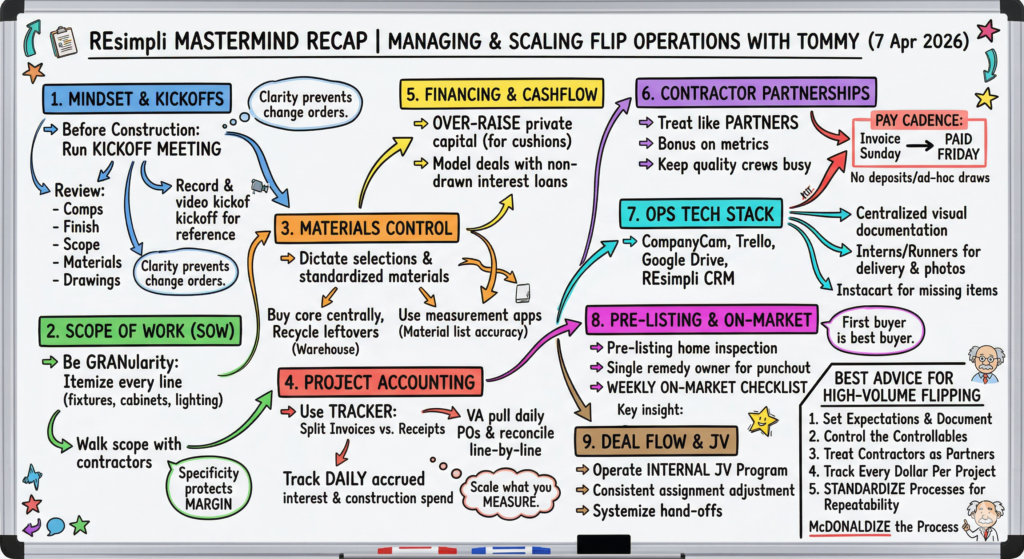
Topic: Mindset & Setting Expectations (Project Kickoffs)
Challenge: Teams rush into rehabs without a unified vision; unclear expectations lead to mid-project changes, cost overruns, and missed ARV targets.
Advice:
Run a kickoff meeting before construction: review comps, finish level, scope, material lists, drawings, and who owns each deliverable. Record/video the kickoff and hyperlink it into the scope so everyone can reference the agreed plan.
Key Insight:
Clarity at the start prevents change orders and chaos later. “McDonaldize” the process so anyone can execute the plan.
Topic: Scope of Work — Be Granular
Challenge: Generic scopes (“kitchen remodel $10K”) create ambiguity, frequent change orders, and loss of margin.
Advice:
Itemize every line (fixtures, cabinets, lighting count, tile type, Schluter detail, left-hand drain, niche, etc.). Walk the scope with your contractors. Use an annotated scope checklist to prompt every detail.
Key Insight:
You don’t lose control by being specific — you protect margin and execution quality.
Topic: Materials — Who Buys What & Inventory
Challenge: Contractors buying materials can create cost creep, lost receipts, and inventory waste at project close.
Advice:
Dictate materials where possible: use standardized selections, buy core materials centrally, recycle leftovers via a warehouse. Use measurement apps (e.g., Qubica-style) to produce accurate material lists. If contractors must purchase, limit to trades that quote labor + material (rough plumbing/electrical/HVAC).
Key Insight:
Controlling materials reduces surprises, improves speed, and creates repeatability.
Topic: Contractor Relationships, Pay Structure & Retention
Challenge: Contractor turnover, slow crews, and disputes over payment timing derail timelines.
Advice:
Treat contractors like partners — learn their lives, bonus on hitting metrics, keep quality crews busy. Pay on line-item completion; no deposits and no ad-hoc draws. Invoice Sunday → paid Friday cadence. Bonus structure: approx. $500 (cosmetic) to $2,000 (full rehab) depending on project complexity. Fire reliably underperforming crews quickly.
Key Insight:
Systems + predictable pay cadence + relationship investment beat price shopping. A reliable, aligned crew is worth paying a premium for.
Topic: Project Accounting & Trackers
Challenge: Scaling without per-project accounting leads to cash confusion, mixed funds, and hidden liabilities (private/hard money owed).
Advice:
Use a project tracker that splits invoices vs. receipts, tracks daily accrued interest, construction spend, and outputs real-time profit and cash-at-closing. Have a VA pull daily Lowe’s/Home Depot POs and reconcile line-by-line into trackers so bookkeepers can reconcile quickly.
Key Insight:
You can’t scale what you don’t measure. Track every dime per project to keep underwriting accurate and avoid scaling chaos
Topic: Financing & Cashflow Management
Challenge: Hard-money timing and draws can stall construction if you don’t plan for gaps.
Advice:
Over-raise private capital on the front end to cover unexpected draws or initial funding shortfalls (e.g., raise 2x the known down to cover gaps). Model deals as if you have 100% financing — non-drawn-interest loans (non-Dutch) improve returns and should be incorporated into underwriting.
Key Insight:
Build funding cushions into deals so construction continues uninterrupted and you’re not constantly chasing capital.
Topic: Ops Tech Stack & Virtual Management
Challenge: Physical oversight becomes impossible at scale; documentation gets lost across chats and drives.
Advice:
Use CompanyCam (or similar) for photo/checklist capture, Trello for scheduling, Google Drive for documents, and REsimpli for CRM/project input where applicable. Employ interns/material runners to deliver materials, inventory, and take checklist photos so you can manage projects virtually. Use Instacart-style deliveries to avoid labor waste on small missing items.
Key Insight:
Centralized visual documentation + lightweight field staff = virtual site management that scales.
Topic: Pre-Listing & On-Market Checklist
Challenge: After rehab, small misses (uncut grass, unchecked heat, remediations) tank first impressions and buyer confidence.
Advice:
Run a pre-listing home inspection and have a single remedy owner (project manager) do the punchout with the realtor. Maintain a weekly on-market checklist (cleanliness, heat, curb appeal) to preserve buyer interest and avoid early market slippage.
Key Insight:
First buyer is usually best buyer — present confidently and eliminate surprises before listing.
Topic: Deal Flow & Internal JV Structure (Wholesale → Flip)
Challenge: Integrating wholesaling and flipping teams can create internal conflict over assignments and pricing.
Advice:
Operate a JV program: log the originating wholesaler/realtor in your CRM, market the deal to your buyers first, and if flipping company keeps it, apply a consistent internal assignment adjustment (Tommy’s rule: sometimes accept a deal paying $5K less to internal buyers). Use the same CRM tasks and drips for JV leads.
Key Insight:
Treat internal channels transparently and systemize hand-offs to capture deals without internal friction.
Tools & Tactics Mentioned
- Detailed annotated scope templates (15‑page annotated SOW)
- CompanyCam (photo/checklist management)
- Measurement apps (Qubica-like) for material takeoffs
- Project tracker spreadsheet (line-item receipts/invoices, daily interest, cash position)
- REsimpli for CRM and JV lead tracking
- Trello + Google Drive for document and scheduling workflows
- Virtual assistants for Lowe’s/HD reconciliation and scope creation
- Instacart for fast material deliveries to job sites
- Warehouse to reclaim leftover materials and reduce waste
Best Advice from the Session
The teams that win at high-volume flipping are the ones who:
- Set expectations and document them (kickoffs, recorded scopes)
- Control the controllables: scope, materials, payments, and data
- Treat contractors as partners (predictable pay cadence, bonuses, retention)
- Track every dollar per project and maintain a live project tracker
- Standardize repeatable processes so the operation can be run by others
If you want the slides and replay, the host will distribute them to attendees. For direct follow-up, Tommy is available on Instagram at TommyHar05 for coaching and community questions.

 Latest Articles
 Sharad Mehta