REsimpli Mastermind Recap – Raising Private Capital with Adam Whitney (Feb 10th, 2026)

This week, we hosted our weekly REsimpli Mastermind session featuring Adam Whitney, CEO of Seven Figure Flipping and Blackjack Real Estate. Adam shared a powerful, practical framework on raising private capital — one of the most important skills for real estate investors at any level.
Whether you’re wholesaling, flipping, or building a rental portfolio, one truth remains:
You need capital — and you need it structured correctly.
Below is a recap of the major topics discussed.
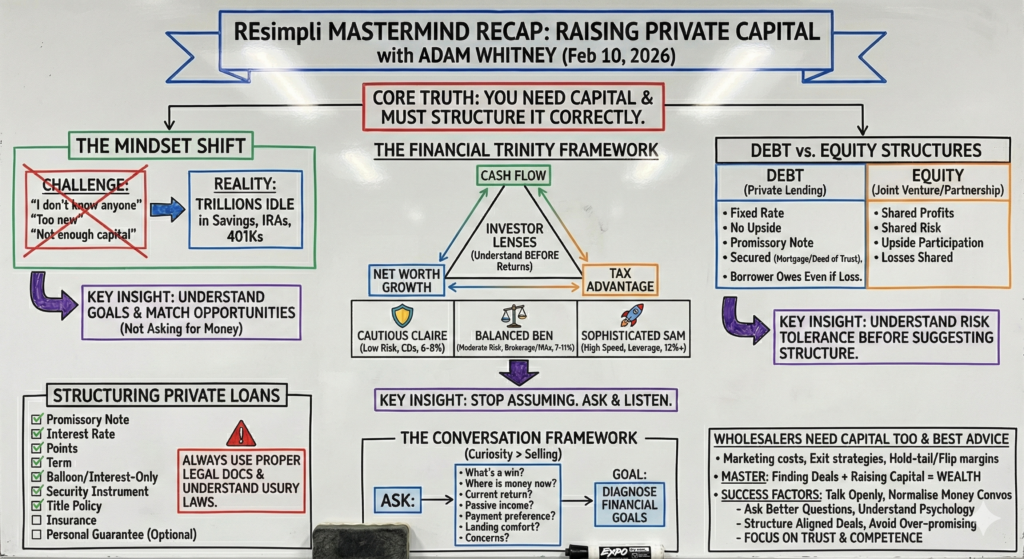
Topic: The Mindset of Capital Raising
Challenge: Many investors believe:
- “I don’t know anyone with money.”
- “I’m too new for people to trust me.”
- “There isn’t enough capital out there.”
Reality:
There are trillions of dollars sitting idle in savings accounts, IRAs, and 401Ks earning minimal returns.
The real problem is not lack of money.
The problem is:
- Not talking about what you do
- Not understanding investor psychology
- Not asking the right questions
Key Insight:
Raising capital is not about asking for money.
It’s about understanding people’s financial goals and matching opportunities to those goals.
Topic: The Financial Trinity Framework
Adam introduced what he calls the Financial Trinity:
- Cash Flow
- Net Worth Growth
- Tax Advantage
Every investor views opportunities through one (or more) of these lenses.
Example:
- A CD investor may only want 6% steady cash flow.
- A stock investor may prioritize long-term appreciation.
- A high-income earner may care most about tax write-offs.
If you don’t understand which lens your investor is using, you may structure the deal incorrectly.
Key Insight:
Before discussing returns, find out:
- What their money is doing now
- What return they’re currently getting
- What kind of return they actually want
Topic: The Three Investor Avatars
Adam broke investors into three clear categories:
Cautious Claire
- Prefers low risk
- Likely uses CDs or savings accounts
- Focused on capital preservation
- Slower decision-maker
- Often comfortable with 6–8%
These investors require high trust and education.
Balanced Ben
- W2 professional
- Has brokerage accounts and IRAs
- Comfortable with moderate risk
- Interested in real estate
- Typically 7–11% range
They’re numbers-oriented and make logical decisions once comfortable.
Sophisticated Sam
- Already lending or investing
- Understands private money
- Wants speed and strong returns
- Comfortable with 12%+ and points
- Fast decision-maker
These investors understand leverage and capital velocity.
Key Insight:
Stop assuming what someone wants.
Ask questions and let them tell you.
Topic: Debt vs. Equity Structures
Adam explained the difference between:
Debt (Private Lending)
- Fixed interest rate
- No participation in upside
- Lender protected via promissory note
- Often secured with a mortgage or deed of trust
If the deal loses money, borrower still owes the lender.
Equity (Joint Venture / Partnership)
- Shared profits
- Shared risk
- Participation in upside
- Losses are shared
The key is educating investors clearly on the difference between the two.
Key Insight:
Never push structure first.
Understand their risk tolerance before suggesting debt or equity.
Topic: Structuring Private Loans Properly
Adam outlined the core components of private lending:
- Promissory Note (IOU outlining terms)
- Interest Rate (annualized)
- Points
- Term Length
- Balloon vs Interest-Only Payments
- Security Instrument (Mortgage or Deed of Trust)
- Lender’s Title Policy
- Insurance Naming
- Optional Personal Guarantee
He emphasized:
Always work with proper legal documentation and understand state usury laws.
Topic: The Conversation Framework
Instead of pitching returns, Adam recommends asking:
- What does a win look like for you?
- Where is your money currently?
- What return are you getting?
- Are you looking for passive income?
- Would you prefer monthly payments or a lump sum?
- Are you comfortable with lending?
- What concerns do you have?
The goal is curiosity — not selling.
Key Insight:
You are not asking for money.
You are diagnosing financial goals.
Topic: Wholesalers Still Need Capital
Even if you’re wholesaling:
- Marketing costs rise
- Exit strategies matter
- Hold-tail or flip opportunities increase margins
Adam emphasized that long-term success comes from mastering:
- Finding discounted off-market deals
- Raising private capital
Those two skills alone can build significant wealth.
Best Advice from the Session
The investors who consistently raise capital successfully:
- Talk openly about what they’re doing
- Normalize money conversations
- Ask better questions
- Understand investor psychology
- Structure deals aligned with investor goals
- Avoid over-promising returns
- Focus on trust and competence
If you can:
- Find off-market deals at a discount
- Raise private capital consistently
You can build a scalable real estate business.

 Latest Articles
 Sharad Mehta