
Using AI to Find Off‑Market Properties & Scale Acquisitions with Cole Ruud‑Johnson
Date: (24 Mar, 2026)
Yesterday, we hosted our twice‑monthly REsimpli Mastermind and invited Cole Ruud‑Johnson to walk through pragmatic, high-ROI ways real estate investors can use AI to find off‑market properties, speed underwriting, improve operations, and protect margins — without falling into “shiny object” traps. Below is a recap of the major topics discussed.
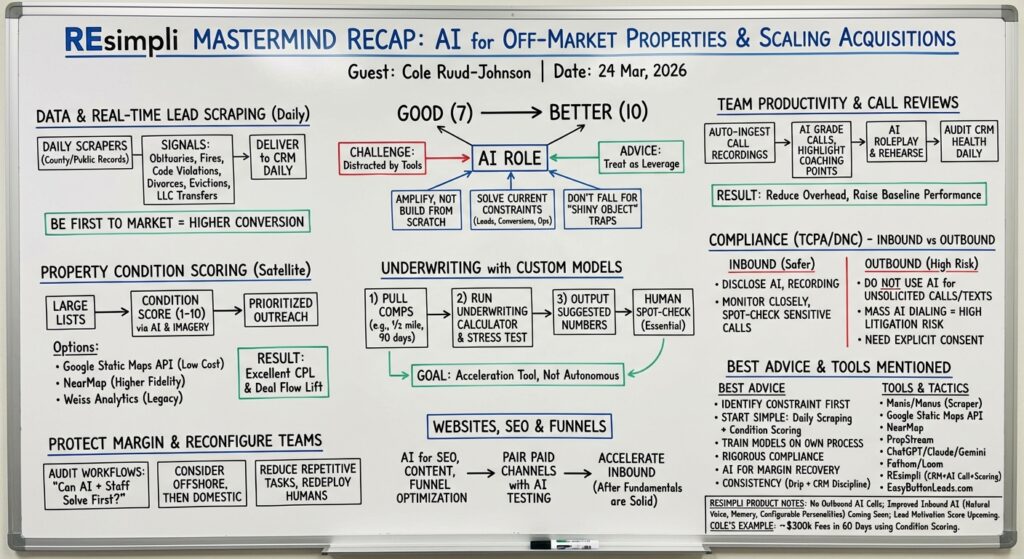
Topic: Where AI Actually Moves the Needle (and where it doesn’t)
Challenge: Entrepreneurs get distracted by a flood of AI tools and spend hours tinkering instead of solving the real constraints in their business (leads, conversions, operations).
Advice:
Treat AI as a leverage tool to solve your current constraint. If you’re still working to get leads and have seller conversations, focus on fundamentals first. If you’re already executing well, use AI to automate data workflows, speed underwriting, score calls, and reclaim margin.
Key Insight:
AI is rarely the thing that builds your business from scratch; it reliably takes you from “good” to “better” — think 7 → 10. Use it to amplify what already works.
Topic: Data & Real‑Time Lead Scraping
Challenge: Most lead lists are stale or miss events that create motivated sellers (obituaries, fires, code violations, divorces, evictions, LLC transfers).
Advice:
Build or buy scrapers that pull daily county and public‑record signals — obituaries matched to property owners, fire reports, new code violations, new filings, etc. Deliver cleaned results into your property database/CRM daily so marketing hits first.
Key Insight:
Being first to market on fresh, public‑record events is a major competitive advantage and will yield higher conversion rates than chasing generic lists.
Topic: Property Condition Scoring (Satellite Imagery)
Challenge: Buying big lists without a way to prioritize properties wastes marketing spend.
Advice:
Use satellite imagery and automation to condition‑score exteriors. Options:
- Low cost: Google Static Maps API (roughly 10k properties for ~$100) + AI to rank condition (1–10).
- Higher fidelity: NearMap (monthly aerial updates) for near real‑time condition.
- Expensive legacy: Weiss Analytics (used to charge ~$1/property).
Key Insight:
Condition scoring turns large lists into prioritized outreach lists. Even basic Google imagery + AI ranking produces excellent CPL and deal flow lift.
Topic: Underwriting with Custom‑Trained Models
Challenge: Underwriting is market specific; generic AI can miss local nuances and lead to bad offers.
Advice:
Train a market‑specific model using your own underwriter recordings, deal history, and underwriting calculator. Workflow:
- Model pulls comps (tight radius — Cole uses 1/2 mile and ~90 days).
- Model runs your underwriting calculator and stress tests scenarios.
- Model outputs suggested numbers for quick review.
- Always spot‑check AI underwriting; it should be an acceleration tool, not an autonomous decision maker.
Key Insight:
When trained on your process and reviewed consistently, AI can massively speed underwriting and increase throughput — but human checks remain essential.
Topic: Call Reviews, Process Mapping & Team Productivity
Challenge: Scaling sales quality and consistency across reps requires continuous coaching and QA.
Advice:
Auto‑ingest call recordings daily, have AI grade calls, highlight coaching points, and surface process gaps. Use AI to roleplay and rehearse objection handling and discovery questions. Let AI audit CRM health daily (who’s on drip, who’s not getting touched).
Key Insight:
AI reduces managerial overhead and raises the baseline performance of reps — freeing owners to focus on strategy.
Topic: Call Answering, Inbound vs Outbound, and Compliance
Challenge: TCPA/DNC law is nuanced and shifting. Outbound AI dialing/robocalls create legal risk.
Advice:
- Outbound: Do not use AI for unsolicited outbound calls/texts unless explicit consent allowing AI contact exists. Mass AI outbound dialing/texting is high litigation risk.
- Inbound: AI for inbound call answering is far safer. It must disclose it’s AI and that calls may be recorded. Monitor inbound AI performance closely and spot‑check sensitive calls (divorce, imminent move/sell).
- Established Business Relationship (EBR) rules vary by state/judge; compliance is messy and case‑law driven — check local rulings as volume grows.
Key Insight:
Use AI for inbound and wrap strict human QA around it. Treat outbound AI dialing as a legal minefield unless you have explicit opt‑ins.
Topic: Using AI to Protect Margin & Reconfigure Teams
Challenge: Rising costs and inefficient teams shrink owner margin.
Advice:
Audit workflows with the question: “Can AI plus existing staff solve this first?” Then consider lower‑cost offshore hires, and only after that hire domestically. Many media, copy, and admin tasks can be reduced with AI plus a small human review team.
Key Insight:
AI’s clearest business value is often margin recovery — replace repetitive tasks, reduce headcount where appropriate, and redeploy humans to high‑value roles.
Topic: Websites, SEO & Funnels
Challenge: Driving organic/inbound lead flow is a slow grind when done poorly.
Advice:
Use AI for SEO, content creation, and funnel optimization (buyer pages, targeted landing pages). Pair paid channels (PPC/PPL) with AI‑powered funnel testing for predictable inbound performance.
Key Insight:
AI can accelerate SEO and funnel improvements, but only after core acquisition channels and sales processes are solid.
Topic: When AI Becomes a Distraction (Golden Object Syndrome)
Challenge: Entrepreneurs spend work hours on tool‑hopping and “building” instead of making offers and having seller conversations.
Advice:
Schedule “AI tinkering” for off hours. Only adopt a tool that directly reduces your business constraint (leads, conversions, or operations). Use AI to answer “how can I solve X?” rather than chasing the latest hype cycle.
Key Insight:
Fundamentals (leads + conversions + ops) beat tool stacking. Use AI to augment — not replace — execution.
Resimpli Product Notes (from the session)
- REsimpli’s AI does not allow outbound AI calls (aligns with TCPA concerns).
- Current inbound Call Answering AI is available; improvements are coming in ~3–4 weeks:
- More natural voice and flow
- Memory across interactions (AI will remember prior conversations and team interactions)
- Configurable personalities/sales tactics (aggressive, laid‑back, etc.)
- Improved call scoring and actionable coaching feedback
- Upcoming lead prioritization: every lead will get a motivation score so teams can focus the highest‑intent leads first.
Tools & Tactics Mentioned
- Manis / Manus (agentic scraper/workflow platform) — used to build daily county scrapers and workflows
- Google Static Maps API (low‑cost satellite images)
- NearMap (higher fidelity aerial updates)
- Weiss Analytics (legacy condition scoring)
- PropStream (equity estimates when uploading lists)
- Batch and other data provider APIs
- ChatGPT / GPT‑4, Claude, Gemini (models for training/custom assistants)
- Fathom, Loom (recording underwriter sessions)
- REsimpli (CRM + inbound call AI + call scoring)
- EasyButtonLeads.com (managed call center service)
- 10DLC / A2P (messaging setup considerations)
- Core tactics: daily scraping/cleanup, condition‑scoring, training underwriting models from recordings, daily call QA and CRM health checks, drip cadence + AI‑assisted followup
Specific Examples & Benchmarks from the Session
- Cole paid about ~$200 to build a daily county scraper with Manis/Manus.
- Weiss Analytics charged ~$1/property (often cost‑prohibitive for large lists).
- Google Static Image API can rank ~10,000 properties for roughly $100 (70–80% accuracy versus real‑time).
- NearMap updates most properties monthly (higher accuracy; used by insurance/roofing).
- Cole reported ~$300k in fees in the last 60 days from using condition scoring and prioritized marketing.
- Underwriting practice: comps within 1/2 mile and ~90 days, then run underwriting calculator and delivery scenarios.
Best Advice from the Session
- Identify your current constraint (leads, conversions, operations). Only adopt AI that directly removes that bottleneck.
- Start simple: daily data scraping + condition scoring + a tight pipeline is the highest ROI for many operators.
- Train AI models from your own recordings and processes for reliable underwriting and call scoring — then spot‑check results.
- Be rigorous about TCPA/DNC compliance: inbound AI is safer; outbound AI dialing/texting is legally risky without explicit opt‑ins.
- Use AI to get margin back. Automate repetitive work, but keep humans for relationship selling and final approvals.
- Consistency in follow‑up (drip campaigns + CRM discipline) still outperforms creative one‑off hacks.
If you want to follow up with Cole: he’s @coleruudjohnson on social platforms and runs Easy Button Leads for managed call center services.

 Latest Articles
 Sharad Mehta
Sharad Mehta
Sharad Mehta
Sharad Mehta
Sharad Mehta