
Cap rate, short for capitalization rate, is a property’s net operating income divided by its purchase price or current market value, written as a percentage. It measures the unlevered annual return a rental property produces, before any mortgage or financing.
Investors use cap rate because it boils a deal down to one number you can compare across properties. A $180,000 rental and a $1.2 million strip mall don’t look alike. Their cap rates do, and that’s the point.
Knowing how to calculate cap rate, and how to read it, separates a fast yes from an expensive maybe. Below, you’ll get the formula, a step-by-step walkthrough, worked examples, good cap rate benchmarks, the factors that move it, and its blind spots.
What Is the Cap Rate Formula?
The cap rate formula is net operating income (NOI) divided by purchase price or current market value: Cap Rate = NOI ÷ Property Value. The result, shown as a percentage, reflects the property’s unlevered rate of return.
Net operating income is the property’s annual income after operating expenses, but before mortgage payments, depreciation, and income taxes. Think rent and other property income, minus taxes, insurance, maintenance, management, and vacancy.
Purchase price (or market value) is what you paid or what the property is worth today. At the moment you buy, the two are usually the same. Later, you’d run the cap rate on current market value.
What the number tells you: a lower cap rate, roughly 3% to 5%, signals a lower-risk, higher-value property in a strong market. A higher cap rate, around 8% to 10%, points to higher risk and potentially higher return.
Neither is automatically better. A 4% cap rate in a prime metro and a 9% cap rate in a secondary market can both be smart buys, depending on your strategy.
| Cap rate range | What it usually signals |
| 3% to 5% | Lower risk, higher value, strong market |
| 6% to 7% | Balanced risk and return |
| 8% to 10% | Higher risk, potentially higher return |
How Do You Calculate Cap Rate Step by Step?
To calculate cap rate, total the property’s gross rental income, subtract operating expenses to get NOI, find the current market value, then divide NOI by that value and convert to a percentage. The whole thing reduces to one ratio: NOI ÷ value.
Here’s the math on a real example. Say you’re looking at a single-family rental listed at $250,000 that brings in $2,000 a month.
- Step 1: Calculate Gross Rental Income
Add up everything the property earns in a year before expenses. Our rental pulls $2,000 a month, so gross rental income is $24,000 a year. Get this number right; the whole calculation builds on it. - Step 2: Subtract Operating Expenses to Get NOI
Operating expenses include property taxes, insurance, maintenance, and management fees. Say those run $8,400 a year ($3,000 taxes, $1,200 insurance, $2,400 maintenance, $1,800 management). NOI is $24,000 minus $8,400, or $15,600. - Step 3: Determine Current Market Value or Purchase Price
You need a value for the denominator. Use the purchase price or estimate current market value from recent comparable sales (comps) or an appraisal. For this property, that’s $250,000. - Step 4: Divide NOI by Market Value
Divide NOI by the value to get the raw cap rate as a decimal. Here: $15,600 ÷ $250,000 = 0.0624. This is the cap rate before you convert it to a percentage. - Step 5: Convert to Percentage
Multiply the decimal by 100. So 0.0624 × 100 = 6.24%, or about 6.2%. Cap rates are quoted as percentages because it makes comparing properties quick and clean.
| Step | Input | Figure |
| Gross rental income | $2,000/mo × 12 | $24,000 |
| Operating expenses | taxes, insurance, upkeep, management | ($8,400) |
| Net operating income | gross minus expenses | $15,600 |
| Market value | comps or appraisal | $250,000 |
| Cap rate | $15,600 ÷ $250,000 × 100 | 6.2% |
What Are Real-World Cap Rate Calculation Examples?
Below are five cap rate scenarios, from a small residential rental to a large commercial asset, plus how interest rates and rent growth change the math. Each shows the property value, NOI, the calculation, and what the result means.
Residential Rental Property Example
This residential rental example uses a $180,000 single-family home. It rents for $1,500 a month, so gross rental income is $18,000 a year. Operating expenses (taxes, insurance, maintenance, management) total $6,300, leaving an NOI of $11,700.
Cap rate: $11,700 ÷ $180,000 = 0.065, or 6.5%. For a residential investor, a 6.5% cap rate is a solid, stable yield in many markets, the kind of steady cash flow buy-and-hold owners want.
Commercial Real Estate Example
This commercial example uses a $1.2 million multi-tenant retail building. Annual rent comes to $144,000. Operating expenses (taxes, insurance, common-area maintenance, management) run $42,000, so NOI is $102,000.
Cap rate: $102,000 ÷ $1,200,000 = 0.085, or 8.5%. That higher cap rate reflects commercial reality. More tenant turnover risk and a thinner buyer pool, so investors demand a bigger return than on a stable home.
Asset Class Comparison Example
An asset class comparison shows why two properties with similar income trade at very different cap rates. The drivers are property type, location, market conditions, and risk.
Take a property valued at $14,000,000 with $600,000 in NOI, and it returns a 4.3% cap rate ($600,000 ÷ $14,000,000). A low cap rate like that usually means a premium asset in a strong market. Here’s how the four drivers pull the number around:
- Property type. Stable types like well-leased apartments price at lower cap rates than higher-turnover types like retail or hospitality.
- Location. Prime, high-demand locations compress cap rates; secondary markets push them up.
- Market conditions. Hot markets with plenty of buyers bid prices up, which drops cap rates.
- Risk. The more uncertain the income, the higher the cap rate buyers demand.
Interest Rate Impact Example
This interest rate example shows how borrowing costs move cap rates, even when income doesn’t change. Take a property with a steady $60,000 NOI. When rates are low and buyers accept a 5% cap rate, the value pencils at $1,200,000 ($60,000 ÷ 0.05).
Now rates climb. Buyers want a 6.5% cap rate to justify the deal, so the same $60,000 NOI supports only about $923,000 ($60,000 ÷ 0.065). Higher rates, higher cap rates, lower values. That’s the relationship.
Rent Growth Scenario Example
This rent growth scenario shows how rising rents lift your return over time. You buy a property for $400,000 with a first-year NOI of $24,000, a 6.0% cap rate. Push rents over three years and trim expenses, and NOI climbs to $28,800.
On your original $400,000 basis, that’s a 7.2% cap rate ($28,800 ÷ $400,000), your yield on cost. This is why investors model rent growth before they buy, not after.
What Is the 1% Rule and the Cap Rate Rule of Thumb?
The 1% Rule says a rental’s monthly rent should be at least 1% of its purchase price after repairs. Cap rate goes deeper: NOI ÷ market value. A common rule of thumb is that a healthy cap rate sits about 1% above prevailing interest rates.
What Is the 1% Rule in Real Estate?
The 1% Rule in real estate is a quick screen: gross monthly rent should be at least 1% of the property’s purchase price after repairs, which signals potential positive cash flow.
On a $200,000 all-in property, you’d want at least $2,000 a month in rent. Clear it and the deal is likely to generate cash flow. Miss it and you dig deeper. It’s a filter, not a verdict, and it leads naturally into a fuller metric like cap rate.
What Is a Good Cap Rate by Property Type?
A good cap rate depends heavily on property type, because each type carries its own risk and income stability. As a general benchmark, cap rates tend to land a point or so above prevailing interest rates, but the spread by type matters more.
- Multifamily. Often the lowest cap rates, roughly 4% to 7%, thanks to strong, steady demand and a deep buyer pool.
- Residential (single-family). Generally 5% to 8%, depending on the market and the neighborhood.
- Industrial. Commonly 5% to 8%, supported by long leases and durable tenants.
- Commercial (retail and office). Often the highest, around 6% to 9% or more, reflecting turnover and tenant risk.
Treat these as rough guides. Exact ranges shift with the market and the rate environment, so always compare against current local data.
What Is a Good Cap Rate by Market?
A good cap rate also depends on the market, since local economics, demand, and interest rates all push it around. The same building earns a different cap rate in Manhattan than in a mid-size Midwest city.
- Primary, high-demand markets. Gateway cities like New York, San Francisco, and Los Angeles often see low cap rates, roughly 3% to 5%, because prices get bid up.
- Secondary and tertiary markets. Smaller or slower-growth markets usually run higher, around 7% to 10% or more, to compensate for lower liquidity and demand.
Interest rates set the floor. A cap rate generally needs to clear prevailing rates by about a point, so a 7% rate environment makes an 8% cap rate look reasonable.
How Do You Use Cap Rate in Real Estate Investing?
Investors use cap rate three ways: to compare deals, estimate value, and gauge risk, all from one ratio of NOI to property value.
Quick example: $80,000 NOI on a $1,000,000 property is an 8% cap rate. Lower cap rates (3% to 5%) signal lower risk and higher value, while higher cap rates (8% to 10%) signal more risk and potential return.
How to Use Cap Rate to Compare Properties?
To use cap rate to compare properties, calculate NOI ÷ purchase price for each, then line up the percentages. A higher cap rate means more income per dollar invested, but it usually comes with more risk.
The strength of cap rate is speed: it normalizes very different deals into one number you can rank. The catch is that cap rate ignores financing and appreciation.
So use it to shortlist, then run cash-on-cash return and other metrics before you commit. Range check: 3% to 5% reads low-risk, 8% to 10% reads higher-risk.
How to Use Cap Rate to Estimate Property Value?
To estimate property value with cap rate, flip the formula: Property Value = NOI ÷ Cap Rate. If a property produces $80,000 in NOI and similar assets trade at an 8% cap rate, the implied value is $1,000,000 ($80,000 ÷ 0.08).
Change the market cap rate to 6%, and the value jumps to about $1,333,000. Two common mistakes sink this: forgetting expenses (which inflates NOI) and ignoring market shifts (which moves the cap rate).
For a fast estimate, plug your numbers into a cap rate calculator or a simple spreadsheet, then sanity-check against comps.
How to Use Cap Rate to Assess Investment Risk?
Cap rate doubles as a risk gauge, because it prices the relationship between expected return and uncertainty. Low cap rates (3% to 5%) point to lower risk and higher value, often premium assets in strong markets. High cap rates (8% to 10%) point to higher risk and potentially higher return.
Where investors slip: over-relying on cap rate alone and ignoring market conditions. A fat cap rate can hide a dying neighborhood or a tenant about to leave. Read the cap rate, then read the story behind it.
How Do Implied Cap Rates and REIT Cap Rates Work?
Implied cap rate is the cap rate baked into a property’s market price and expected income, often used to value REITs. You back into it: divide expected NOI by the price the market is paying.
For a REIT, the implied cap rate reflects how investors feel about the whole portfolio’s risk and growth, not just one building.
A low implied cap rate signals confidence and high valuations; a high one signals caution. The same ranges apply: 3% to 5% low, 8% to 10% high. They’re a fast read for quick analysis.
What Are the Benefits of Using Cap Rate?
The main benefits of cap rate are quick deal screening, apples-to-apples property comparison, market benchmarking, and risk assessment without financing variables. They all flow from one ratio, NOI relative to property value, with a 5% to 10% cap rate a common healthy range.
- Quick Deal Screening: Cap rate gives a fast read on whether a property’s income justifies its price, so you can filter deals in seconds instead of building a full model for every listing.
- Apples-to-Apples Property Comparison: By normalizing income against value, cap rate lets you compare wildly different properties on the same footing, a $200,000 duplex next to a $2 million retail center.
- Market Benchmarking: Comparing a property’s cap rate to local averages flags over- and under-valued deals. A cap rate well above market can signal a bargain, or a problem worth investigating.
- Risk Assessment Without Financing Variables: Because cap rate excludes your mortgage, it isolates the property’s own performance, showing intrinsic risk before your loan terms muddy the picture.
Just remember cap rate is one lens. Pair it with cash flow and cash-on-cash return for the full picture.
What Factors Affect Cap Rate?
Cap rates are driven by a number of factors such as the property type and asset class, location and market demand, net operating income and vacancy, operating costs and management quality, interest rates, and investment strategy. Stronger markets and higher-quality assets push cap rates down (lower risk, higher value), while weaker ones push them up.
- Property Type and Asset Class: Property type (multifamily, office, retail) and asset class (A, B, C) set the baseline. Premium Class A apartments price at lower cap rates than a Class C retail strip, because buyers see less risk.
- Location and Market Demand: Prime locations near highways, transit, and amenities draw demand and competition, which compresses cap rates. Weaker locations push cap rates higher to attract buyers.
- Net Operating Income and Vacancy Rate: Higher NOI lifts the cap rate; higher vacancy cuts NOI and drags it down. An $80,000 NOI on a $1,000,000 property is an 8% cap rate; lose tenants and that number falls.
- Operating Costs and Management Quality: Bloated expenses shrink NOI and the cap rate. Sharp management that controls costs and keeps units full protects NOI and supports a stronger cap rate.
- Interest Rates and Macroeconomic Conditions: Rising rates typically lift cap rates as borrowing gets pricier; strong economic conditions can compress them by boosting demand. Cap rates ride the market cycle.
- Investment Strategy. Your strategy sets your target. Core buyers accept lower cap rates for stability; value-add and opportunistic buyers chase higher cap rates for bigger upside.
How Can You Mitigate Cap Rate Risk?
Mitigate cap rate risk by increasing NOI, reducing operating expenses, improving occupancy, diversifying across asset classes and markets, and monitoring interest rate trends. Cap rate risk is the chance your value slides as markets shift, and moving between the 3% to 5% and 8% to 10% bands hits hard.
- Increase NOI Through Rent Optimization: Push NOI by setting rents to market, renegotiating leases, and adding value through units, amenities, or fees. Higher NOI strengthens your cap rate and cushions downside.
- Reduce Operating Expenses: Trim costs by renegotiating service contracts, improving energy efficiency, and streamlining maintenance. Every dollar of expense you cut flows straight to NOI and your cap rate.
- Improve Occupancy and Reduce Vacancy: Keep units full with targeted marketing, tenant retention, and flexible leasing. Higher occupancy stabilizes NOI and steadies the cap rate.
- Diversify Across Asset Classes and Markets: Spread capital across property types and markets so one local downturn doesn’t sink the whole portfolio. Diversification smooths returns and cap rates.
- Monitor Interest Rate Trends: Watch rates closely. Rising rates often lift cap rates and pressure values; stable or falling rates support them. Across the 3% to 5% versus 8% to 10% bands, rate moves can reprice your asset.
What Are the Limitations of Cap Rate?
The main limitations of cap rate are that it ignores financing, doesn’t account for future cash flows, relies on accurate NOI estimates, struggles with value-add or vacant properties, and varies widely across markets. It’s a useful input, but never the sole call.
- Ignores Financing and Leverage: Cap rate reflects only the property’s unlevered return. It doesn’t account for your mortgage, so debt-using investors must also check cash-on-cash and levered returns for the real picture.
- Does Not Account for Future Cash Flows: Cap rate focuses on current or stabilized NOI. A property with planned rent hikes or looming expenses can show a misleading cap rate, which is why investors run discounted cash flow analysis for forward views.
- Relies on Accurate NOI Estimates: Cap rate is only as good as your NOI. Underestimate vacancy or expenses and the result flatters the deal. Careful due diligence on income and costs keeps the number honest.
- Ineffective for Value-Add or Vacant Properties: Cap rate can’t reflect upside or empty buildings. For heavy renovations or lease-up periods, lean on metrics like cash-on-cash return, IRR, or projected stabilized value instead.
- Varies Significantly Across Markets: Cap rates differ by local demand, risk, and property mix. Comparing a city cap rate to a rural one without context misleads. Compare within similar markets, not across them.
How Can the Right Tools Streamline Cap Rate Analysis?
The right tools turn cap rate analysis from spreadsheet busywork into a few clicks. Cap rate calculators and deal software apply the NOI ÷ value formula instantly, cut manual errors, and show a property’s unlevered return, what it earns as if you paid all cash.
That speed matters when you’re screening dozens of deals. Here’s how the tools work, from a basic calculator to a full CRM.
How to Use a Cap Rate Calculator?
A cap rate calculator estimates a property’s capitalization rate so you can compare opportunities fast. Using one takes three steps:
- Gather your inputs: Pull the property’s net operating income (NOI) and its current market value or purchase price.
- Enter the values: Type the NOI and the value into the calculator’s fields.
- Apply the formula: The tool runs Cap Rate = NOI ÷ Market Value and returns a percentage.
Read the result like this: a higher cap rate generally means higher risk and higher potential return, a lower one means the opposite. Most calculators also let you reverse the math to estimate value from a target cap rate.
How CRM Software Helps Investors Track Cap Rates at Scale?
Running cap rate on one property is easy. Running it across a portfolio, while juggling leads, offers, and follow-ups, is where a real estate CRM earns its place.
A CRM built for investors centralizes everything in one system: property data, contacts, deal stages, and performance numbers. Instead of cross-referencing five tools, you work from a single record per property.
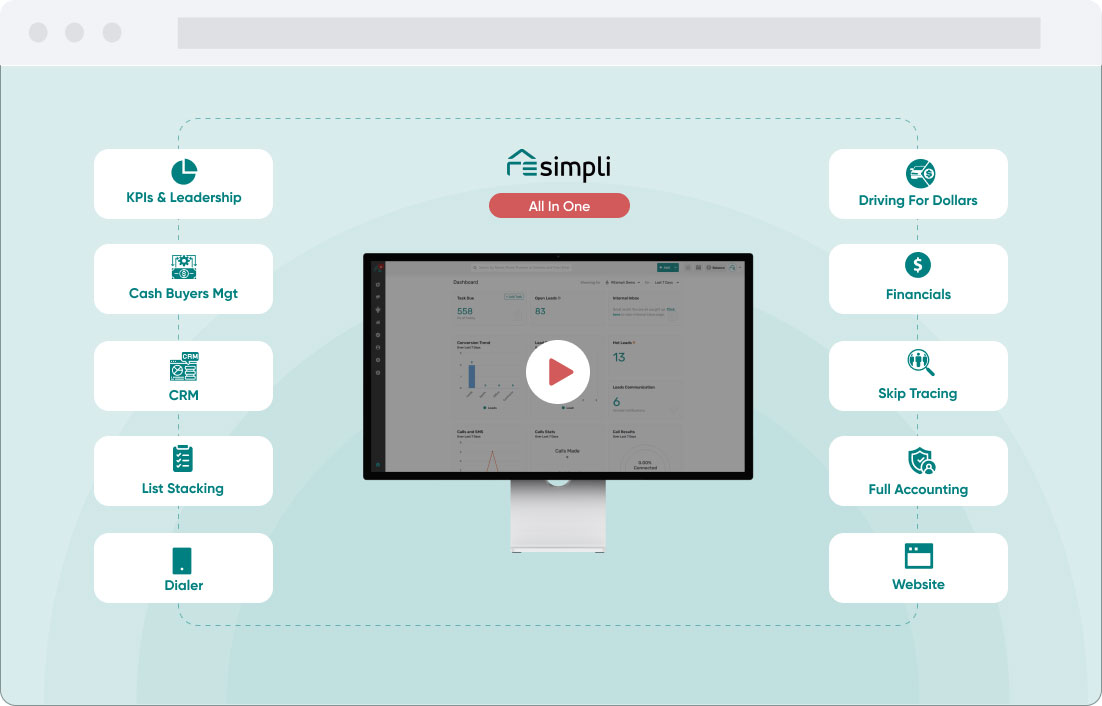
Take an all-in-one platform like REsimpli. It auto-pulls property data, valuation, tax, mortgage, and last-sale info, from third-party providers, so the inputs behind your NOI and value sit right on the lead, no manual hunting.
From there, every property moves through a pipeline (new lead to under contract to sold or rental), and a built-in deal calculator handles your offer math, ARV and the 70% rule (MAO). A KPI dashboard tracks marketing ROI and performance across deals.
For a rental-focused metric like cap rate, the win isn’t a magic button. It’s clean, current property numbers and your whole portfolio in one place, so the math, and the decision, comes faster.
What Other Metrics Should You Track Alongside Cap Rate?
Cap rate is a useful but largely backward-looking snapshot, so smart investors never run it alone. Track these alongside it:
- 1% Rule: A fast screen where monthly rent should be at least 1% of the purchase price after repairs. It flags likely cash-flow deals before you build a full model.
- Gross Rent Yield: Annual gross rent divided by property value, before expenses. It’s a quick top-line read on income relative to price, useful for first-pass comparisons.
- Cash Flow: The actual dollars left after all operating expenses and debt service. Unlike cap rate, cash flow reflects your financing, the money that hits your pocket each month.
Use them together. Cap rate ranks the deal, the 1% Rule screens it, gross rent yield sizes the income, and cash flow tells you what you’ll actually keep.
Cap rate tells you whether a property’s income fits its price. Learn the formula, run the examples, and keep your NOI inputs honest.
And keep your numbers in one place. An all-in-one CRM like REsimpli centralizes your property data, pipeline, and KPIs, so when it’s time to run cap rate across your portfolio, the inputs are ready. Get started with REsimpli.

 Latest Articles
 Sharad Mehta
Sharad Mehta
Sharad Mehta
Sharad Mehta
Sharad Mehta